Sabtu, 11 Desember 2021

Testosterone Xxl Review

Testosterone Xxl Review

If you're looking to put a spark in your sex life, it might be tempting to order some male enhancement supplements, also known as penis enlargement supplements.

These dietary supplements can be purchased without a prescription. Companies make lofty promises of big benefits, such as an elevated libido and larger penis. Male enhancements seem to be everywhere these days. But do they work?

Like some prescription medications (Viagra) that treat erectile dysfunction (ED), alternative male enhancement supplements work to increase blood flow to the penis.

If you have certain health issues, such as liver disease or hypertension, your doctor may advise staying away from alternative or prescription pills to support ED.

As with any supplement in the United States, penis enlargement supplements are not regulated by the Food and Drug Administration (FDA). So it's important to do your homework and speak with a healthcare professional if you have questions.

This article looks at one specific supplement, Viril X.

Viril X enhancement is sold by Dignity Bio-Labs in Pacoima, California. The company sells a variety of supplements intended for cognitive, joint, and prostate support, among others.

Viril X is made with a mix of 21 ingredients:

  • American ginseng
  • avena sativa
  • barrenwort leaves
  • boron citrate
  • catuaba bark
  • cayenne
  • eleuthero root
  • ginger
  • kola nut seed
  • Korean ginseng
  • L-arginine HCL
  • L-citrulline
  • maca leaves
  • muira pauma
  • nettle leaves
  • niacin
  • orchic substance
  • pumpkin seeds
  • sarsaparilla
  • tribulus terrestris
  • zinc
Viril X

Viril X is a proprietary blend, which means the company doesn't have to release the amount of each ingredient they use in the product.

Viril X is intended to support the production of testosterone (which declines with age) and nitric oxide (which can enhance sexual function).

One ingredient, L-arginine, is the precursor to nitric oxide, a molecule that influences the body's soft muscle areas, one being penile tissue.

L-arginine's role in treating erectile dysfunction symptoms has been studied, and results show some positive findings.

A 2019 review article highlighted various research studies on L-arginine used, alone or in combination with another drug, for ED treatment.

According to the article, "positive evidence is available for the efficacy of l-arginine and its various combinations." However, the number of studies are limited and have small sample sizes.

On the other hand, nitric oxide is a neurotransmitter that's the building block of an erection. It acts as a relaxant, allowing blood vessels to open up or dilate, swelling the tissues.

Many of the ingredients in Viril X are natural remedies speculated to boost blood flow and energy, decrease inflammation, increase testosterone levels, and keep the penis and attending organs functioning well.

However, scientific research on these claims is hit or miss at best.

It's always best to consult with your doctor before taking any natural supplement.

With ED, the inability to achieve and sustain an erection isn't unusual. Sometimes, ED presents as a reduced interest in sexual activity.

If you're experiencing these symptoms, talk with your physician, says Dr. Puja Uppal, a board certified family medicine physician and the chief medical officer at Think Healthy.

However, it's unlikely a urologist will prescribe these supplements to assuage ED symptoms. ED is a complex condition that involves systemic health, hormones, and state of mind.

Uppal says there could be a number of underlying health conditions causing ED symptoms, such as sleep apnea, diabetes, heart disease, ADHD, and other mental health issues. You may not even know you have one of these conditions.

"I never advise my patients to take non FDA regulated supplements, because we simply don't know what's in them," she says.

A 2017 study says the prevalence of ED in patients with chronic kidney disease is high. The more advanced your kidney disease, the more likely you'll have ED symptoms. The study also found that more than 80 percent of those with late-stage kidney disease also experienced ED.

While the ingredients in Viril X are natural, it doesn't mean they won't cause side effects.

Ginseng, pumpkin seeds, and cayenne have been shown to cause mild irritation in some people. And natural stimulants can cause anxiety in people sensitive to caffeine or similar substances.

Likewise, if you're on any medication at all, it's best to speak with your doctor first.

Each of the ingredients in Viril X has the potential to react with a prescription drug.

L-arginine, for example, shouldn't be used if you're on antiplatelets or anticoagulants. It could increase the risk of heavy bleeding. It's also thought to have reactions with medications for the heart, diabetes, and blood pressure.

Some online reviewers complain of diarrhea after taking Viril X. One reviewer says Viril X caused stomach cramps.

You can order Viril X through the Dignity Bio-Labs site. Other retailers, like Amazon, GNC, and eBay, also carry the product.

Bottles of Viril X come with a 30-day supply. The company recommends taking two pills every day with 8-ounces of water.

  • One bottle: $54.95
  • Three bottles pack: $48.95 per bottle
  • Six bottles pack: $42.95 per bottle

The Dignity Bio-Labs website says they conduct third-party testing on their products. They manufacture in the United States in an FDA registered facility in Utah.

Their website says, "The production facilities our products are produced in have met stringent performance standards regarding cleanliness and maintenance."

Dignity Bio-Labs is not accredited with the Better Business Bureau. They have 21 listed complaints on the site, most of which involve people seeking refunds. Some complaints have been rectified.

Customers get a 100 percent no-risk guarantee. If you're unhappy with Viril X, you can get a refund up to 90 days from purchase.

The company offers free shipping to the United States and Canada.

Reviews on Viril X's efficacy are mixed. Some reviewers rate the product highly and say they will purchase more. Other positive reviews state they had more energy for work or the gym.

Some lackluster reviews say the product doesn't work. Some reviewers note there's a 15 percent restocking fee deducted from their refunds. Others say they didn't receive the product.

One reviewer rates the product 4 stars, saying, "It takes time to see the effects."

There are several comments online complaining the product does nothing.

On the Dignity Bio-Labs site, however, the product has more than 3,700 ratings, averaging more than 4 stars.

There are no clinical trials or clinical data for Viril X.

How long will I need to take Viril X to see a difference?

Some online reviewers say it takes a few weeks of taking the supplements regularly to see a difference. Others say Virile X has never worked.

Natural supplements respond differently from person to person.

Are there any negative long-term effects of taking Viril X?

There aren't any recorded negative long-term effects from taking Viril X.

This might be due in part to the lack of clinical trials. We just don't know enough about the product to conclude if there are long-term side effects.

Can I take more than the recommended amount if I find two pills aren't working?

You should not take more than the recommended dose.

Viril X is composed of roots and herbs, some of which have shown to spark allergic reactions. Ginseng is one of these plant ingredients. It's shown to initiate insomnia, headaches, and dizziness — and that's just one of the 21 ingredients in Viril X.

It might be tempting to try Viril X, or a similar supplement, if you're experiencing a low libido or symptoms of ED.

However, any natural supplement is not subject to FDA rules, and they can keep proprietary ingredients and recipes private.

If you're on any prescription medications, you shouldn't take a supplement without consulting a doctor. If you're having symptoms of ED, they could be caused by an underlying health condition that's unrelated to sex.

Tracee Herbaugh is a writer and journalist who lives in the Boston area. She writes about culture, lifestyle, health, and family relationships. You can view her work online or find her on Twitter.

Testosterone Xxl Review

Source: https://www.healthline.com/health/mens-health/2021-viril-x-review

Share:

Jumat, 10 Desember 2021

Taking Raspberry Ketones On A Low Carb Diet

Taking Raspberry Ketones On A Low Carb Diet

  1. peterj7

    Messages:
    1
    Likes Received:
    0
    Trophy Points:
    21
    hi all

    can anyone tell me if it`s safe to use the ,(Raspberry Ketone Diet ) and has anyone tried it yet,

    thanks pete

  2. MCMLXXIII

    MCMLXXIII Type 2 · Well-Known Member

    Messages:
    1,816
    Likes Received:
    201
    Trophy Points:
    103
    I take a small punnet of raspberries each morning and combine with cinnamon and flaxseed with either soya yoghurt or porridge.
    Brilliant fruit and good for you in so many ways.
    I could go on but do google for a full list of benefits.

    Sent from my KFTT using DCUK Forum mobile app

  3. phoenix

    Messages:
    5,672
    Likes Received:
    3,675
    Trophy Points:
    178
    I remembered the name of this supplement because of a thread about it on another diabetes forum a while ago. (google diabetes raspberry ketone warning), A regular poster reported that his wife suffered extreme feelings of jitteriness and anxiety when she took the supplement. There are quite a few comments from people who have used the supplement, not many positively and some said that glucose and or BP was raised. ( strangely most of these posts about experience seem to come from one time only posters, not sure what to make of that)

    The supplement has not undergone the safety trials or any trials that show it to work in humans.

    http://www.webmd.com/vitamins-supplemen ... entId=1262
    • Like Like x 2
  4. mrs love

    Messages:
    6
    Likes Received:
    0
    Trophy Points:
    21
    i saw an ad for these and tried to see if the diabetes was affected by them as ketones for us diabetics aint good!!
    It just adviced to go see your gp before taking them!! Thats a help NOT
  5. Raspberry ketone diet refers to a diet prepared from raspberry ketone which is a natural compound found in red raspberry. It help one deal with basically all the challenges that usually slow the weight loss process which include the hardship of managing cravings, boosting up your low metabolism and burning up more fat in your body.
    • Like Like x 2
  6. kocall

    Messages:
    20
    Likes Received:
    8
    Trophy Points:
    23
    hi i tried rassberry ketone and after reanding so many good results about them i had to have a go sorry to tell you but the only thing that ended up any lighter was my purse lol
    i even made my partner who doesn't have diabetes and perfect body weight try them after 2 weeks she gained 2lb x

    Sent from the Diabetes Forum App

    • Like Like x 2
  7. Timnut1

    Messages:
    4
    Likes Received:
    14
    Trophy Points:
    43
  8. Timnut1

    Messages:
    4
    Likes Received:
    14
    Trophy Points:
    43
    I tried the raspberry ketone diet. I didn't get any side effects. I had a bit of dry mouth though. I drank plenty of water and lost quithe a bit of weight. I found it on amazon
  9. Please don't even go near this. People who are diabetic should not be doing this. If you do please go to your gp and tell them you intend to do the ketone diet. So they can keep an eye on you.
    Please be carefull i did this and suffered alot :(
  10. My wife and I are thinking of starting Rashberry Keystones and Green Tea extract. This will be in the new yr. we need to know if I can take them as I have a great deal.of trouble loosing weight.

    I need some proper help with this.

    Thanks

  11. The origin of this thread was 3 years ago. there have been a number of scams involving raspberry ketones. Have a read up on the Low Carb diet thread in these forums to help with both weight loss and blood sugar control rather than wasting money on supplements.
  12. Cheers mate. no I haven't we want to try the key tones 1st
  13. Your choice of course.. but usually if something sounds too good to be true....
    LCHF works as a lot of us can testify.. I'm nearly 7 stone down on it.
  14. Marie834

    Messages:
    1
    Likes Received:
    0
    Trophy Points:
    21
  15. Mbaker

    Mbaker Type 2 (in remission!) · Well-Known Member

    Messages:
    4,136
    Likes Received:
    8,828
    Trophy Points:
    178
    I agree, as in my signature, my biggest loss over the shortest time frame was LCHF. I would suggest I am a stereotypical T2 in terms of response. My combination of raspberries, strawberries, blue berries, black berries, with several nuts, flax seeds with either full fat yoghurt or 35 grams of water cooked oats (if you can tolerate) keeps me full for between 6 and 7 hours (including a HiiT workout), and keeps a consistent weight.
  16. I think I'd rather listen to Dr Fung anyday...
    • Agree Agree x 1
  17. catherinecherub

  18. GrantGam

    GrantGam Type 1 · Well-Known Member

    Messages:
    2,604
    Likes Received:
    1,579
    Trophy Points:
    178
    Your best bet for weight loss, dietary ketosis. You'll only get there via LCHF. If you don't get into dietary ketosis, you'll more than likely lose weight anyhow.

    I don't fully understand the mechanics behind the whole "raspberry ketone" phenomenon. But I do know that a lot of companies have made a lot of money by making a lot of people out of pocket.

Taking Raspberry Ketones On A Low Carb Diet

Source: https://www.diabetes.co.uk/forum/threads/raspberry-ketone-diet.37073/

Share:

Paleo Diet Low Carb High Protein

Paleo Diet Low Carb High Protein

person having laksa for breakfast

Muhammad Wahizul Haswan Abdul Aziz / EyeEm

High-protein, low-carb eating plans are all the rage right now in the nutrition world, from the keto diet to the paleo diet to Whole30.

And for good reason: High-protein, low-carb diets have been shown to help with weight loss. (That said, many of diets are incredibly difficult to follow over a long period of time, despite short-term benefits, so proceed with caution.)

But beyond trendy diets, high-protein low-carb diets have another benefit: lean muscle gain. A study published in the Journal of Nutrition found that eating high-protein meals—containing about 30 grams of protein—throughout the day stimulated greater muscle protein synthesis.

"The general recommendation for protein intake is between .8 g- 1.2 g per kilogram of body weight," says Sandra J. Arevalo, M.P.H., R.D.N., spokesperson for the Academy of Nutrition and Dietetics. "Of course, you'll need more protein to maintain muscular and lean mass."

Of course, if you're looking to follow a high-protein, low-carb diet, it's important not to totally cut out carbs. "Going high-protein, low-carb often means people are cutting out variety of foods from their diet and therefore not meeting all their other dietary needs," says Arevalo. "It's always important to fill half your plate with veggies."

Yes, vegetables contain carbohydrates. It's about finding balance.

Ready to stock your kitchen? Here are 23 high-protein, low-carb foods to help you stick to your diet—trendy or not.

1 of 23

Eggs

"They're quick to cook and inexpensive," says Arevalo. Plus, they're super versatile: have them hard boiled, deviled, or in an omelet.

Per one whole, large egg: 72 calories, 7g protein, 0g carbs, 5g fat

2 of 23

Milk

"Besides the nice amount of protein, milk is an excellent source of calcium and vitamin D," says Arevalo. (If you're on the restrictive keto diet, just be sure you don't overdo it.)

Per 1-cup serving (low-fat): 101 calories, 8g protein, 12g carbs (og fiber), 3g fat

3 of 23

String Cheese

"Cheese sticks are perfect for on-the-go breakfast and snacks. Plus they're low fat," says Arevalo.

Per cheese stick: 50 calories, 6g protein, 1g carbs (0g fiber), 3g fat

5 of 23

Greek Yogurt

"Greek yogurt is packed with protein and is perfect for breakfast, snack time or dessert," says Arevalo. But watch out for added sugars—stick with plain instead.

Per one 7-oz container (plain, low-fat): 146 calories, 20g protein, 8g carbs (0g fiber), 4g fat

6 of 23

Peanuts

"Dry roasted peanuts offer a good amount of protein, plus a great amount of fiber," says Arevalo.

Per 1.5 oz. serving: 250 calories, 10g protein, 9g carbs (4g fiber), 10g fat

7 of 23

Almonds

"Nuts are an excellent source of protein. Compared to peanuts, almonds have more fat, so pay attention to portion size," says Arevalo.

Per 1.5 oz serving: 254 calories, 9g protein, 8g carbs (5g fiber), 18g fat

8 of 23

Whey Protein Powder

"I love whey protein powder. It's high in protein and low in carbs (depending on sugar content), and great in smoothies where you can add in other veggies and fruit," says Arevalo. (With so many options on the market, you can pick the one that fits for you.)

Per 1 Tbsp serving: 45 calories, 5g protein, 2g carbs (1g fiber), 2g fat

9 of 23

Shrimp

"Seafood is usually a great pick for high-protein, low-carb diets. I like shrimp because they cook quickly and are low in calories for the amount of protein they pack," says Arevalo. (Try one of these keto-approved shrimp recipes.)

Per 100 grams: 99 calories, 24g protein, 0g carb, 0g fat

10 of 23

Chicken Thighs

"Although chicken breasts may be lower in fat, chicken thighs have the same amount of protein and lots of flavor," says Arevalo.

Per 3 oz serving: 393 calories, 14g protein, 0g carbs, 37g fat

11 of 23

Edamame

"Boiled or raosted, they;re the perfect snack packed with plant protein," says Arevalo.

Per 1-cup serving: 188 calories, 18g protein, 14g carbs (8g fiber), 8g fat

12 of 23

Deli Turkey

"Deli turkey is the perfect lunchtime protein option," says Arevelo. Consume in moderation, though, as it's often a highly processed meat.

Per 2-oz serving: 62 calories, 12g protein, 2g carbs (0g fiber), 1g fat

13 of 23

Peanut Butter

"Be careful to stick with portions—although peanut butter is packed with good fat, fat is fat," says Arevalo.

Per 2-Tbsp serving: 187 calories, 10g protein, 13g carbs (2g fiber), 12g fat

14 of 23

Beef Jerky

"It's low in fat and packed with protein," says Arevalo. Seriously, who doesn't love beef jerky? (Here are 10 brands we love.)

Per 1-oz serving: 116 calories, 9g protein, 3g carbs (0g fiber), 7g fat

15 of 23

Tofu

"I love vegetarian meat substitutes—they're great sources of protein," says Arevalo.

Per 1/2 cup serving: 142 calories, 12g protein, 4g carbs (1g fiber), 8g fat

16 of 23

Canned Tuna

"Apart from the protein, tuna is low in saturated fat and is a great source of B vitamins," says Arevalo. (Canned is the perfect pick for lunch—try this healthy tuna salad recipe.)

Per 3 oz serving: 73 calories, 17g protein, 0g carbs, 1g fat

17 of 23

Oysters

Yeah, oysters. They're higher in protein, have negligible calories, and contain a veritable ocean's worth of vitamins and minerals.

Per 12 medium Eastern wild: 86 calories, 10g protein, 4g carbs (0g fiber, 3g fat

18 of 23

Bison

Superlean and powerfully flavorful, bison is the other red meat.

Per 3 oz ground, grass-fed, cooked: 152 calories, 22g protein, 0g carbs, 7g fat

19 of 23

Lobster

Slightly more expensive than chicken breast? Yes. Infinitely more awesome-tasting than chicken breast? Without a doubt.

Per 3 oz northern, cooked: 83 calories, 17g protein, 1g carbs (0g fiber), 1g fiber

20 of 23

Duck Breast

Oh, faaaaancy. Actually, it's not that much harder to cook than skin-on chicken breast. Crisp the skin in a hot pan, flip, pop the pan to a 350°F, and cook till done. Simple, really.

Per 3 oz cooked: 172 calories, 21g protein, 0g carbs, 9g fat

21 of 23

Tempeh

It's maybe of fermented soy beans, which are high in protein by nature. Sear it and add to soups, stews, and chilis.

Per 3 oz cooked: 165 calories, 15g protein, 9g carbs, 9g fat

22 of 23

Calamari

It's squid (surprise!), but it's inexpensive, easy to cook (grill it, don't fry it), and supremely delicious.

Per 3 oz raw: 78 calories, 13g protein, 3g carbs (0g fiber), 1g fat

23 of 23

Pork Chops

Despite what the marketing campaign stated, pork is actually a red meat. That means lots of flavor for plenty of protein and not a carb.

Per chop: 190 calories, 33g protein, 0g carbs, 7g fat

Paleo Diet Low Carb High Protein

Source: https://www.menshealth.com/nutrition/g24173507/high-protein-low-carb-foods/

Share:

Senin, 06 Desember 2021

Can U Eat Oatmeal On Low Carb Diet

Can U Eat Oatmeal On Low Carb Diet

*This post may contain affiliate links. Please see my disclosure to learn more.

Oatmeal is widely famous as a comforting breakfast dish that is popular for its heavenly creaminess, delicious taste and chewy texture. Oatmeal is pretty versatile as it can be incorporated into a wide range of mouthwatering recipes. On top of that, it's a great source of essential nutrients, but is it ok to eat oatmeal on a keto diet?

Low-carbohydrate diets restrict the consumption of carbohydrates, however oat fiber is pure insoluble fiber. Dietary fiber is low-carb and keto friendly because it does not dissolve in water and is not absorbed into the digestive tract.

You have already revealed all the benefits of oatmeal in the above sections. Now, the question arises – whether oatmeal is preferred for the keto diet. Are you allowed to eat oatmeal on keto? Or, is there any restriction as such?

Well, oatmeal is 66% carbohydrates including 11% dietary fiber and can't be directly allowed for those who are following a keto diet. However, there are a few special factors and points that you must note to understand how you can incorporate oatmeal on keto.

What is the keto diet?

Keto diet, alternatively termed as the ketogenic diet, has been so popular nowadays. This diet has three special features i.e. it relies on moderate protein, low-carb, and higher-fat food options.

The high fat diet will even help you when it comes to weight loss because the selection of food is aimed to help you burn excess body fats more effectively. But, how does eating fat help you to lose body fat?

This diet plan will drastically reduce your carbohydrate intake and replace it with fat.

Needless to say, carbohydrates are the main source of energy for our body cells, organs, and tissues. Your body will break down carbohydrates into blood sugar or glucose.

However, for the ketogenic diet, the above process won't be applicable. High consumption of fat will allow your body to shift the energy source from glucose to fat.

Rather, your body will rely on fat (instead of carbohydrates) for getting the required energy. This particular state of the body is known as ketosis where it limits your carb intakes and even shifts consumption to burning fat from stored energy within the body.

Can you eat oatmeal on a low-carb diet?

Oatmeal contains a large percentage of nutritional value in the form of complex carbohydrates. For example, if you consume a big bowl of oatmeals (around 100 grams), it will have carbohydrate content of around 66 grams.

That's why oatmeal may not be 100% suitable if you are following a strict low-carb diet or keto diet. However, it all depends on which low-carb diet you are following and it's also based on your personal dietary choice options.

So, if you can pair up a small portion of oatmeal with a hefty portion of fats and protein, then it will reduce the overall carb intake. In this way, not only will will fulfill your carbohydrate allotment for the day, but it will also further allow you to follow a keto diet regime.

Can you eat oatmeal on a low carb diet?

Can you eat oat fiber on a keto diet?

Yes, you can. Oat fiber is the outer hulls of the whole grain oats, which are not digestible in the body, therefore oat fiber is completely keto-friendly.

Oat fiber is not the same as oat flour. It's not processed from the grounded oat groats.

Instead, it's made from the fibrous outer husk of the oat. That's why it's purely insoluble fiber.

The best part of oat fiber is that it contains just three grams of dietary carbs per teaspoon. Since its carb content is indigestible compared to the regular oatmeal, it can be a perfect addition to your keto diet.

Why is oatmeal bad for keto?

Oats may not be completely bad for keto, but the only problem lies in its carb content of oatmeal. Since oatmeal is derived from the whole-grain content, it constitutes a good portion of carbs.

As already mentioned, a 100-gram serving of oatmeal will have 66 grams of carbs, including 55 grams of net carbs. Due to its high carb content, oatmeal is not directly preferred for keto.

Note, ketogenic diet followers rely on low-carb, high-fat, and moderate-protein food options. If you are following a keto diet, you will require to reduce your carb content.

But, it's not like that your keto diet won't have any place for a carb-content food option like oatmeal.

Keto diet does not ask you to reduce your carb content to 0%. Rather, you will have to wisely balance out your options.

For example, you can balance your oatmeal (carb content) with other food options that have increased levels of fats and proteins. In this way, your keto diet will be maintained as well as your body will get a wealth of nutrition and health benefits from oatmeal.

Is oatmeal carbs bad?

No, oatmeal carbs are not bad. Rather, these are known as healthy carbs.

Rest assured that these whole, fiber-rich foods are extremely healthy for your body. Most people have a common misconception carbohydrate contents lead to weight gain, but this is not the case for oatmeal.

There is a huge difference between healthy carbs and bad carbs. Healthy carbs will never induce weight gain.

Instead, they supply a bunch of vitamins, minerals, antioxidants, and many essential nutrients. The perfect example is oatmeal, a nutritionally wholesome food.

On the contrary, bad carbs are closely linked to weight gain. That's why you are recommended to reduce the intake of bad carbs as much as possible.

For keto diet, you are required to follow a low-carb diet i.e. you should reduce the intake of those food options that contain bad carbs. Since oatmeal is based on healthy carbs, please feel free to include small portions in your calculated diet.

Can you eat oatmeal and still lose weight?

Yes, you can eat oatmeal and you will still lose weight. Oatmeal carbs are essential for your health and in fact the oatmeal diet is entirely based on eating whole grain oats for every meal.

Oatmeal is very filling i.e. it means they will keep your stomach and appetite full for a long time. Plus, they reduce unwanted hunger pains as well.

Furthermore, many bodybuilders and high performance athletes incorporate oatmeal recipes into their power packed diet.

Since oatmeal keeps your stomach full for a significantly long time and decreases hunger pangs, it will definitely help you lose weight. When consumed in moderation, there is no doubt about it.

Keto Oatmeal: Final Thoughts

With this analysis, we have revealed the complete information about eating oatmeal on a keto diet. It's indeed true that oatmeal is a rich source of carbohydrates, but the good thing is that these are healthy carbs.

Oat fiber is the ultimate addition to the keto diet. Oat fiber is a byproduct of whole grain oats, but it is not oatmeal.

The carbs are net neutral because the insoluble fiber content is not digested in the body. Therefore, the dietary fiber passes though the digestive tract without nutritional value being absorbed.

Modest consumption of healthy carbs will not increase your body weight. In fact, a small amount of healthy carbs are allowed for keto diets, thats why it's a low carb diet and not a zero carb regimen.

Even if the keto diet focuses on low-carb food options, you can still intake oatmeal without a dilemma (considering it as a healthy carb food option). Just make sure to balance your diet with some high fat and moderate protein food options for the best outcomes.

Can U Eat Oatmeal On Low Carb Diet

Source: https://simplyoatmeal.com/can-you-eat-oatmeal-on-keto/

Share:

Snacks To Eat On Low Carb Diet

Snacks To Eat On Low Carb Diet

Photo Courtesy: @ww_us/Twitter

Unless you're a child, you've probably heard cautionary tales from your doctor about the dangers of high cholesterol. It has been linked to heart-related conditions such as atherosclerosis and an increased risk of heart attack or stroke. Cholesterol is a critical component in evaluating your heart health, so if your doctor has ever ordered blood work for you as part of a routine exam, it probably included information about your blood cholesterol levels.

If you aren't familiar with how cholesterol works, it is a waxy substance that moves through your bloodstream to different parts of the body that need it to form new cells. Although your body must have a certain amount of cholesterol, the liver already produces all the cholesterol you need, which means that consuming foods with high amounts of cholesterol could cause excess cholesterol to build up in your blood vessels and cause blockages. To minimize this risk, it's important to keep your LDL (low-density lipoproteins) low and your HDL (high-density lipoproteins) high. You can usually accomplish this by eating a low cholesterol diet and getting plenty of exercise.

For most people who don't have hereditary conditions that cause high cholesterol, dietary changes can help lower bad cholesterol (LDL) levels and increase good cholesterol (HDL) levels. Meal plans that focus on heart health, such as diets recommended by the American Heart Association and the National Heart, Lung, and Blood Institute, will generally help improve cholesterol levels.

These eating plans focus on reducing saturated fats to no more than 5% to 6% of your daily calorie intake and trans fats to zero or at least very minimal levels. This generally means eating very little red meat and avoiding dairy products made with whole milk, such as many cheeses. Instead, your meals should include plenty of heart-healthy poultry, fish and nuts for protein as well as whole grains, fruits and vegetables. Fish containing high levels of omega-3 fatty acids make the best option.

Only healthy oils like vegetable oil should be used and only occasionally. The amount of cholesterol consumed in a day should not exceed 200 milligrams. Incorporating foods with high levels of soluble fiber into your diet is also a great choice. High-fiber diets have reduced cholesterol levels by up to 10% in some people. Sodium has been linked to high blood pressure and is another ingredient to limit when choosing your foods.

Cooking Practices for Lowering Cholesterol

Cooking meals to help lower your cholesterol doesn't have to mean serving boring, unappealing dishes with no flavor that no one in your family will enjoy. When you cook with whole ingredients and healthy fats and minimize sodium, you can prepare recipes that are delicious and satisfying that also promote good heart health.

When you cook meat, start by minimizing the amount of saturated fat by selecting the leanest cuts and trimming off any visible fat. Broil, roast or bake meats instead of frying them, preferably using a pan with a rack that separates the cooking meat from the fat drippings. For poultry, always remove the skin and remember that chicken and turkey have less fat than duck and goose. Ironically, the best fish options include oily fish that are high in omega-3 fatty acids, such as salmon and trout. Processed meats like bologna and hot dogs should always be avoided.

Sheet pan cooking is one simple example of creating a complete meal using a single pan filled with ingredients that are baked in the oven. Simply choose a lean meat like chicken breast or wild-caught salmon, cut it up into bite-sized pieces and place it on a baking sheet sprayed with a vegetable-based cooking spray. Add chunks and slices of onions, bell peppers, red potatoes, broccoli, asparagus, green beans and other fresh vegetables. Sprinkle a little extra-virgin olive oil on the vegetables and season with your favorite salt-free seasonings. Bake at about 400 degrees Fahrenheit for about 20 to 30 minutes until the meat is fully cooked and the vegetables are tender.

Eating Fruits and Vegetables to Lower Cholesterol

Doctors recommend adding a wide variety of fresh fruits and vegetables to your diet for many reasons, including controlling cholesterol levels. However, vegetables boiled in a pan on the stove without the addition of delicious bacon fat may not hold a lot of appeal for your family. Try a different approach with vegetables by cooking them in a small amount of healthy oil — 1 to 2 teaspoons for about 4 servings — with your favorite salt-free seasonings added to boost the flavor.

Fruits are delicious served fresh, but they can also help you cut cholesterol in some recipes. Try using pureed or mashed fruits in muffins, cakes and cookies in place of oil. It cuts the saturated fat content and gives the sweets a whole new enhanced flavor profile. Cooked apples in muffins and mashed bananas in banana bread are great examples.

Eating Whole Grains to Lower Cholesterol

When the goal is heart health, whole grains serve the body much better than refined grains like white flour and white rice. When eating breads and grains in your diet, it's easy to make some simple replacements that still taste delicious. For example, swap whole grain breads for other breads, including many wheat breads, which aren't automatically whole grain. Use brown rice in recipes instead of white and choose a whole grain or veggie pasta instead of traditional pasta.

Plant Sterols and Supplements for Lowering Cholesterol

Sterols are natural substances found in plants that help lower cholesterol levels in the blood by blocking the absorption of cholesterol. LDL cholesterol levels could be reduced by 5% to 15% simply by adding 2 grams of plant sterols to your diet. They occur naturally in fruits, vegetables, nuts, legumes and other plants and are sometimes added to other products like orange juice and margarine.

Certain other ingredients and supplements could help lower your cholesterol, although the results aren't always consistent. Artichokes, barley, blond psyllium and oat bran could possibly reduce total cholesterol and LDL cholesterol. Flaxseed, soy protein and green tea may reduce LDL cholestrol. Taken as a supplement, niacin could possibly reduce LDL cholesterol and increase HDL cholesterol. Garlic has been a popular option for lowering cholesterol for a while, but its success has not been proven. Another supplement, red yeast rice, could be dangerous due to naturally occurring lovastatin and should be avoided.

Resource Links:

https://www.mayoclinic.org/diseases-conditions/high-blood-cholesterol/symptoms-causes/syc-20350800

https://www.mayoclinic.org/diseases-conditions/high-blood-cholesterol/diagnosis-treatment/drc-20350806

https://www.heart.org/en/health-topics/cholesterol/about-cholesterol

https://www.heart.org/en/health-topics/cholesterol/prevention-and-treatment-of-high-cholesterol-hyperlipidemia

https://www.heart.org/en/health-topics/cholesterol/prevention-and-treatment-of-high-cholesterol-hyperlipidemia/cooking-to-lower-cholesterol

https://www.mayoclinic.org/diseases-conditions/high-blood-cholesterol/in-depth/cholesterol-lowering-supplements/art-20050980

https://www.mayoclinic.org/diseases-conditions/high-blood-cholesterol/in-depth/cholesterol/art-20045192

MORE FROM SYMPTOMFIND.COM

Snacks To Eat On Low Carb Diet

Source: https://www.symptomfind.com/health/diet-lower-cholesterol?utm_content=params%3Ao%3D740013%26ad%3DdirN%26qo%3DserpIndex

Share:

Are Pretzels Good For A Low Carb Diet

Are Pretzels Good For A Low Carb Diet

Photo Courtesy: GlobalStock/Getty Images

Food provides your body with the energy it needs to perform all of life's basic functions, from breathing and pumping blood to more complicated movements and tasks. Even in a state of rest, your body is constantly working. Case in point: your body uses most of its energy stores while resting, which is why it's important to replenish those stores by consuming enough calories each day.

According to the U.S. Department of Agriculture (USDA), a person assigned male at birth should consume between 2000 and 2800 calories per day, whereas a person assigned female at birth should consume between 1600 and 2400 per day on average. Any diet that contains 800 calories a day or less is considered a low-calorie diet. While unhealthy fad diets might lure folks into visions of ultra-quick weight loss, an 800 calorie diet can pose serious health risks, especially if it's not prescribed by your doctor.

In some cases, doctors prescribe low-calorie diets to patients, but, unlike the folks behind fad diets, a medical professional will ensure that there's not only a legitimate, urgent need for the diet, but that the patient will receive all the nutrition and support they need while following the regimen.

Here, we'll delve into the ways a very low-calorie diet can be unsafe and unhealthy as well as some more realistic alternatives when it comes to weight loss goals.

Your body needs nutrients, such as fiber, vitamins, minerals, and protein, to stay healthy day-to-day and in the long term. For example, you need calcium for bone health, potassium or magnesium for heart health, and fiber for gut health, to name a few. Without enough calcium, you put yourself at an increased risk for bone diseases and fractures.

 Photo Courtesy: VioletaStoimenova/Getty Images

Without enough potassium or magnesium, your heart rhythms could become irregular, you could experience heart palpitations, or you could have a stroke or heart attack. Too little fiber can lead to constipation, unhealthy blood sugar levels, and even colon cancer. With a diet of 800 calories a day, it's almost impossible to get all the nutrients your body needs.

2. You'll Feel A Lot More Sluggish

A very low-calorie diet will cause your body to go into survival mode. This means your muscles will start to break down for their stored glucose to get your body the energy it needs to function. Even if you work out, your muscle mass will likely decline, giving you less strength for movement of all kinds.

 Photo Courtesy: Kathrin Ziegler/Getty Images

Furthermore, without consuming enough calories per day, your metabolism starts to slow down in an effort to conserve energy. This will also cause you to feel a lot of unnecessary fatigue.

3. Your Overall Quality of Life Will Probably Decline

Very low-calorie diets can cause a slew of different negative side effects that are not only bad for your health, but uncomfortable. Most likely, you will always feel hungry and extremely fatigued. You may also experience constipation, diarrhea, dizziness, stomach cramps, headaches, dry mouth, and hair loss.

 Photo Courtesy: LaylaBird/Getty Images

Very low-calorie diets can also lead to an eating disorder. For instance, extreme calorie-cutting can trigger spiked hunger levels, leading to binge eating. Most would probably agree that the pain and discomfort that comes with an 800 calorie a day diet alone make it not worth pursuing.

4. Your Mental Abilities Won't Be As Sharp

Your brain needs a continuous supply of glucose to function normally. Without it, your mental prowess will begin to lag. Glucose isn't the only thing your brain needs either. Nutrients are also necessary to keep it running correctly.

 Photo Courtesy: Image Source/Getty Images

When you put your body through a very low-calorie diet, your starved brain could easily forget how to do basic tasks like cooking an egg or turning on a lamp. Your ability to focus on anything from a simple conversation to a television show to your work will also decline.

5. You'll Increase Your Likelihood For Gallstones

One of the most common serious side effects of an 800 calorie a day diet is gallstones. This happens because your body will begin to break down fat to get the energy it is missing, which, in turn, causes the liver to secrete higher-than-normal levels of cholesterol.

 Photo Courtesy: Ruben Earth/Getty Images

When that high cholesterol combines with bile, gallstones can easily form. Gallstones are common for people who are rapidly losing weight. They cause a significant amount of abdominal pain and can even require surgery.

6. The Weight Loss Typically Does Not Last

A meta-analysis of 29 studies (see Resource Links) found that low-calorie diets helped people lose weight in the short term. However, that weight loss usually did not last long-term.

 Photo Courtesy: stockvisual/Getty Images

The reason for this is simple: once you stop the diet, the weight comes right back. Because an 800 calorie diet is not even remotely sustainable for health reasons, steer clear of it, as it won't even give you the results you want.

Alternatives to a Very Low-Calorie Diet

An 800 calorie a day diet is dangerous and unsustainable. Instead, if you want to lose weight by cutting calories, there are several, much safer alternatives.

Try Intermittent Fasting

Intermittent fasting is a pattern of eating where you have periods when you can eat and periods when you cannot. It doesn't matter what you eat during your eating times. The only restriction is when you eat. Some of the most common intermittent fasting cycles are 16-hour and 24-hour fasting periods. The 16-hour fasting cycle allows you to eat for eight hours each day. The 24-hour fasting method is done only twice per week.

Fasting was a part of human evolution; back in the hunter-gatherer days, limited access to food sources meant that people went for day without eating. As such, humans evolved with the ability to function without eating for longer periods of time. Intermittent fasting has become a popular way to lose weight, and studies have shown it to be safe and effective as well when done properly. Be sure to consult a nutritionist or medical professional before starting a fasting regimen.

 Photo Courtesy: yulkapopkova/Getty Images

Try a Slightly Higher Calorie Count Per Day

The 800 calorie per day diet may be unsafe, but upping your daily calorie count just a tad is not generally considered dangerous. There are many easy-to-follow 1200 calorie diets and 1200 calorie menus around, and the 1200 calorie diet is within the standards of health safety for many folks. The 1400 calorie diet is another great option for people of all genders. Overall, researchers have found both the 1200 and 1400 calorie diets to be safe and effective ways to lose weight. So long as you consume enough nutrients each day, restricting your calorie count can be done safely.

Resource Links:

  • "Long-term weight-loss maintenance: a meta-analysis of US studies" viaThe American Journal of Clinical Nutrition
  • "Estimated Calorie Needs per Day by Age, Gender, and Physical Activity Level" via U.S. Department of Agriculture (USDA)
  • "Very low calorie diets" via National Health Service (NHS)

MORE FROM SYMPTOMFIND.COM

Are Pretzels Good For A Low Carb Diet

Source: https://www.symptomfind.com/health/dangers-of-very-low-daily-calorie-intake?utm_content=params%3Ao%3D740013%26ad%3DdirN%26qo%3DserpIndex

Share:

Low Carb Diet How Many Grams Of Carbs Per Day

Low Carb Diet How Many Grams Of Carbs Per Day

Photo Courtesy: [Phil Fisk/Cultura/Getty Images]

Carbs may be delicious, but, depending on your health status and any conditions you may have, they may not be the most nourishing (or healthy) macronutrients for you to eat. However, that doesn't mean you can't enjoy your favorite typically higher-carb foods — it just means you need a bit of creativity and a few tips and tricks for making modifications. That's especially true when it comes to a classic breakfast favorite: quiche.

Traditional quiche begins with a pie crust as its base, which isn't ideal if you're limiting carbs. But, by removing the crust — or using some delicious, low-carb substitutes — you can still enjoy the delicate egg and zesty ingredient combinations that make this dish so versatile. Start diversifying your low-carb breakfast menu (or even your evening meals) with these easy crustless quiche recipes.

Crustless Vegetable Quiche

Photo Courtesy: [EasyBuy4u/Getty Images]

Starting the day with an array of healthy vegetables — plus the protein from eggs — on your plate is never a bad idea. That's why this crustless vegetable quiche is such a nice option: You get great flavors and all the nutritional benefits of whatever veggies you add. Plus, it's vegetarian friendly. Even if you're not fully vegetarian, there are some great reasons to try this quiche; forgoing meat once in a while and upping your consumption of fresh produce can improve your cholesterol levels, for one.

This recipe from Food.com calls for broccoli, red pepper and zucchini, though you can swap them out for other vegetables if you prefer. Mushrooms, asparagus and tomatoes are tasty options as well. All are great sources of different vitamins, minerals and fiber. Add the cheese of your choice and some salt and pepper or other spices for an easy way to change up the flavor profile.

Crustless Quiche Lorraine

 Photo Courtesy: [jaker5000/Getty Images]

Quiche Lorraine might be one of the most classic (and best-known) recipes for this dish — and it's just as delicious without the crust. If you're looking for a keto-friendly breakfast dish that helps you reach your daily protein goals, this crustless quiche Lorraine, also from Food.com, is a top option.

Generally, people who follow the ketogenic diet get about 75% of their daily calories from fat, 20-30% from protein and around 5% from carbs. This recipe gets its fat and protein from the eggs, bacon and Swiss cheese you'll use. If you want to add a vegetable for extra flavor and nutrients, try spinach; it's relatively low in carbs but packed with healthy vitamins A and K.

Bacon Cheeseburger Keto Breakfast Quiche

 Photo Courtesy: [John Rizzo/Getty Images]

Looking for more crustless quiche options that work just as well for dinners as they do your morning meals? You'll want to try this bacon cheeseburger keto quiche from Kalyn's Kitchen. It satisfies keto fat and protein requirements thanks to its ground beef, bacon, eggs and the cheese of your choice (we recommend sharp cheddar). For a little bit of low-carb veggie crunch, add a handful of green onions and pickles into the mix too — yes, pickles in crustless quiche. They really do elevate this dish with their crunch and zesty tang.

Spicy Southwest Crustless Quiche

 Photo Courtesy: [yipengge/Getty Images]

For those on the keto diet who also like a little kick to their meals, this spicy Southwest crustless quiche from the folks at Wisconsin Cheese will definitely satisfy any flavor cravings. It's packed full of fat and protein thanks to its eggs, heavy whipping cream, milk and pork sausage. Add some jalapenos, green peppers and pepper jack cheese to crank up the spice level.

As with most of the quiche dishes in this list, you'll cook this in a greased pie dish at 350 degrees Fahrenheit until the edges are golden brown and the center of the quiche no longer looks runny or jiggly. It may take about 45 minutes to achieve the right cooked consistency, and you can also tell the quiche is done — as with many baked treats — when a knife inserted into the center comes out clean. Let the quiche stand for about 10 minutes to fully firm up before slicing into it.

Vegan Crustless Quiche

 Photo Courtesy: [Cavan Images/Getty Images]

This one is a bit of a surprise — a unique and flavorful surprise. You already know quiche is an egg dish, and eggs aren't vegan. So you might also be wondering how a vegan version could exist. In showcasing some true culinary creativity, this vegan crustless quiche from The Spruce Eats utilizes tofu, dairy-free crumbled cheese, soy or almond milk, nutritional yeast, ground cashews and dairy-free cream cheese.

The result is a smooth, authentic crustless quiche that's perfect for people who eat a plant-based diet or those who are allergic to eggs. In addition to its healthful egg-free base, it's got asparagus, garlic and turmeric to spice things up just right. You can always add or substitute your preference for other veggies as well; consider using what's in season to enjoy them at their peak of freshness.

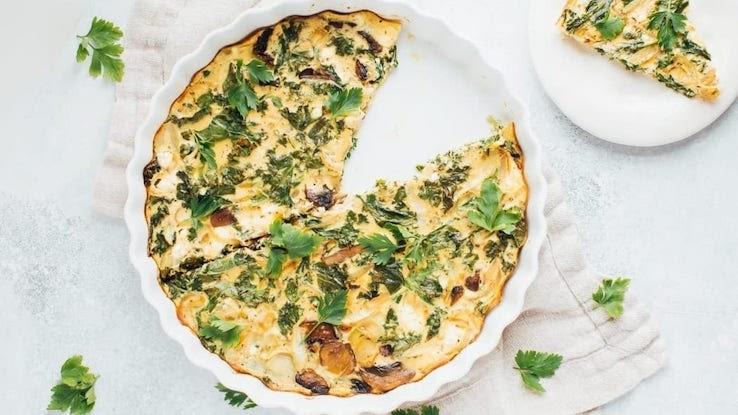
Kale and Feta Crustless Quiche

 Photo Courtesy: [Kale and Feta Crustless Quiche/Eating Bird Food]

Eating Bird Food's kale and feta crustless quiche recipe is an easy yet flavorful low-carb meal that makes for not only a delicious breakfast but also an ideal main course for lunch or dinner. Simply pair a slice with a cup of soup or a salad to create a well-rounded meal. As an added bonus, this recipe is a little different from other basic crustless quiches, which can keep your taste buds on their toes while giving you a nutrient boost at the same time.

Aside from the kale, feta and eggs — its star ingredients — this recipe uses coconut oil, almond milk, mushrooms, garlic, nutmeg and parsley. And here's an interesting tidbit of information about kale: It's a superfood that's chock-full of vitamins and minerals — but that's also low in calories and carbs.

Resource Links:

https://nutritiondata.self.com/facts/vegetables-and-vegetable-products/2626/2

https://www.mayoclinichealthsystem.org/hometown-health/speaking-of-health/the-many-types-and-health-benefits-of-kale

MORE FROM SYMPTOMFIND.COM

Low Carb Diet How Many Grams Of Carbs Per Day

Source: https://www.symptomfind.com/health/basic-crustless-quiche-recipes?utm_content=params%3Ao%3D740013%26ad%3DdirN%26qo%3DserpIndex

Share:
 
banner